Últimas noticias

LS-Based 16 Cylinder Engine Takes Marine World By Storm; Will Show Cars Be Next?

XVI didn't want to add length to the engine so modified the K&N filter to house the throttle

K&N filters are mounted inside custom covers on both ends of the motor

If a cast aluminum 854 cubic inch V16 engine based on the Chevrolet LS architecture seems like an extreme way to generate big horsepower, you need to take a look at the work of the engineers at XVI Power in Detroit, Michigan.

Initially designed for powerboat applications, the crew at XVI Power said that they’d love to see the engine mounted in a few street rods or custom cars. Despite the fact that the engine has four more cylinders, it’s only a foot longer than a Viper V10

The concept behind the motor is that as high-end boat V8 engines are beginning to reach 1,600 horsepower, they’ve become near-race motors with all the maintenance and durability issues related to developing over 200 horsepower per cylinder. And while race teams understand and plan for the kind of abuse a race engine sees, boat owners, perhaps a tad unrealistically, expect these heavily-tweaked motors to provide reliable, long-term service.

The alternative, as XVI Power saw it, was to reduce the load on any single cylinder by increasing the total number of cylinders. Therefore, a cylinder that was expected to produce the stressful 200 horsepower now delivers a more rational 100 horsepower per cylinder, according to XVI team member, Tom Robinson.

XVI wanted to use as many LS components as posible, to make repairs and upgrades easy

The V16 engine in all its glory, the LS design basis is clear even from this view

The XVI Power team chose the Chevrolet LS architecture as the basis, and Caleb Thomas designed and developed a single cylinder block for all 16 cylinders. The A356-T6 aluminum block is cast and machined by a firm in the Detroit area that does a great deal of prototype work for the auto industry so the quality is high. One variation for the LS engines is that the dry sump oil and two-stage water distribution begins and ends at the center of the block for more even distribution. This was a lesson learned by Thomas when he was program manager on the Cadillac V16 show car of 2003.

That gap in the cylinder bore allows for the use of Chevrolet LS cylinder heads, from mild to wild, at the owner’s discretion. In fact, many parts come directly from the LS design, with the only major parts coming from XVI Power being the engine block, crankshaft (supported by ten main caps machined into the oil pan and using big block bearings), the oil pan itself, and the gun-drilled single piece camshaft. Duramax bearings are an option for supercharged or turbo applications. Valves, lifters, rockers, manifolds, many fittings, gaskets, and seals, are all standard Chevrolet items so when any maintenance is required, the parts are close by the marine repair shop.

Here you can get a good view of the piping on the water-cooled headers

Here you can get a good view of the piping on the water-cooled headers

Despite the perception of the V16 being a large engine, a great deal of attention has been focused on making it as compact as possible. All drive ancillaries are kept tucked tight, as are the exhaust manifolds. Even the heat exchangers are low and tight to the block and the throttle bodies have been tucked inside modified K&N E-3514 filters to make sure the induction package didn’t extend past the ancillaries. The mounting hardware is the same as used for a big block. In essence, the installation of the XVI engine is about the same width and length as a Chevy big block-based motor.

Performance is staggering. The basic engine runs with the ignition firing every 45 degree, making for a very smooth running engine regardless of output. And that range of output starts at the basic 900 horsepower and moves up through to a 1,400 horsepower model, all normally-aspirated. Forced induction will be offered latter with a 1,600 horsepower supercharged version and 2,000 horsepower with a quad turbocharger setup. We can’t wait to see the first show car with an XVI engine.

clear

K&N PRODUCT SEARCH     WHERE TO BUY K&N

K&N Ayuda A Hacer Posible El Campeonato Mundial de Resistencia GTE Para Aston Martin

Varios componentes del suministro han de ser utilizados, incluyendo tapones, culatas y el cigüeñal

El motor del Aston Martin V8 está limitado a 480 caballos de potencia por medio de un restrictor de toma

Aunque se fundó en 1913 por Lionel Martin y Robert Bamford (el nombre Aston viene de una pista de escalada). Después de la Segunda Guerra Mundial el salvador de la compañía fue el fabricante de tractores David Brown, cuya iniciales DB aún honran los modelos de hoy en día.

Una fuerza motriz internacional en las carreras de coches a finales de los 1950s, Aston Martin incluso ganó el prestigioso 24 Horas de Le Mans en 1959 con el futuro constructor de Cobra Carroll Shelby y Roy Salvadori conduciendo un Aston Martin DBR1

Pasarían más de cuarenta años antes de que Aston Martin montase un esfuerzo sólido con su producción de coches deportivos en carreras internacionales, y finalmente ha dado fruto este año. Los conductores de Aston Martin Racing Nicki Thiim y Marco Sørensen, ambos de Dinamarca, han conseguido el campeonato GT después de alzarse con la victoria en Campeonato Mundial de Resistencia FIA en la final de Baréin.

Los coches GTE son fabricados a partir de un caparazón estándar, como se requiere en las reglas, junto con un número de especificaciones estándar. La potencia de un motor V8 se ha aumentado a 480 caballos, y se ha reposicionado en el chasis para distribuir mejor el peso. La válvula de aire al Aston Martin V8 se agarra por palas en el parachoques delantero, aprieta los restrictores de toma requeridos, y luego a través de tubos hasta un filtro de aire K&N.

La atención cuidadosa a lo aerodinámico no está ya solo limitada a coches de carreras monoplaza

Las reglas de este año permitían in difusor trasero más grande, lo que ayudó mucho a Aston Martin

Encajada internamente está una jaula de seguridad según los estándares actuales de la FIA. La conducción está asistida por potencia hidráulica, mientras que los cambios de marcha se hacen a través de una palanca de cambios semi-automática hasta una caja de cambios secuencial de seis velocidades Xtrac. Los frenos consisten en seis agarraderas Brembo en la delantera, y cuatro en la trasera. Los amortiguadores son productos ajustables en cuatro direcciones de Bilstein.

Al completo el coche pesa 2745 libras o casi 1000 más que el DBR1 de 1765 libras de Carroll Shelby.

Al llegar la última carrera de la temporada el equipo de conducción Danés sacaba ventaja de 12 puntos en la batalla de GT Drivers, con el equipo por delante de su competidor más cercano en el campeonato GTE Pro con una ventaja de dos puntos. Mientras que llegar en tercer puesto les daba los puntos necesarios para lograr el título GT Driver, los Danese tomaron la victoria con estilo al lograr su segundo primer puesto de la temporada, asegurando el campeonato GTE Pro para Aston Martin Racing en el proceso.

Las eliminatorias fueron tan bien como se podía suponer de Aston Martin, mientras el equipo se ponía en primer-segundo lugar en el GTE Pro y en posición de pole en el GTE AM para el fin de semana del Campeonato Mundial de Resistencia FIA de 6 Horas en Baréin. Después de que el sol se pusiese y las temperaturas bajasen en el desierto de Baréin, el V8 Vantage GTE número 98 de Darren Turner (Reino Unido) y Jonny Adams (Reino Unido) hicieron idénticas vueltas de 1:56.953 para agarrar la posición pole para la carrera del día siguiente. La pareja estuvo seguida de los líderes de los campeonatos GTE Pro y GT Drivers Nicki Thiim (Dinamarca) y Marco Sørensen (Dinamarca), que llevaron a casa su entrada del número 95 con una media de 1:57.081 por vuelta para bloquear la primera fila de la parrilla de salida GTE Pro.

Es apropiado que las carrera se realizase en condiciones secas, ya que la caja fue desarrollada para coches de sprint

El Aston Martin utiliza una caja y filtros altamente modificados

Después de batallar duramente en la carrera con el AF Corse Ferrari 488GTE número 51 durante las primeras horas, el dúo acumuló una ventaja de 20 puntos para la quinta hora. Con sus rivales presionando duro en las últimas etapas para cerrar el hueco, Thiim trabajó duro para mantener la ventaja hasta el ondear de la bandera de cuadros, terminando 12.695 segundos sobre la segunda plaza.

El compañero de equipo de Thiim Sørensen añadió, “Es absolutamente increible ganar el campeonato y voy a decir que es aún más increíble ganarlo con un hermano danés como Nicki. Cuando teníamos 10 años competíamos el uno contra el otro en carreras de kart pero estar aquí ganado el campeonato con él y con Aston Martin Racing es fantástico."

clear

BUSQUEDA DE PRODUCTO     DONDE COMPRAR K&N

Aquí No Hay Aburridos Sedanes: El Presidente de K&N Conduce un Challenger SRT Hellcat Tuneado

El Hellcat incluye una toma de aire K&N, como también modificaciones en la suspensión y la carroza.

Este Dodge Challenger Hellcat de 2016 es propiedad del Presidente de K&N.

Si tan solo te le echases un rápido un vistazo al Dodge Challenger Hellcat de Tom McGann, se te perdonaría pensar que has avistado un raro ejemplar superviviente del Chrysler Direct Connection para armar de los primeros años 1970. Tan solo la capa exterior ya da la impresión de ser un coche de carreras Late Model de la época de Jimmy Carter.

Por entonces, mientras que Chrysler dominaba las pistas de alta velocidad de NASCAR, Chevrolet era prácticamente dueño de la pistas cortas locales. Para darle un mordisco al trozo de mercado de Chevy a toda prisa, Chrysler desarrolló un coche para pistas cortas con Petty Enterprises, quien también vendió las partes a los corredores. Alrededor de esa época Chrysler virtualmente cerró todos sus programas, ya que la compañía estaba al borde de la bancarrota. Sobreviven muy pocos de esos coches.

Pero en espíritu estos coches aún viven hoy en día en Challengers como el Hellcat propiedad de Tom McGann, quien también resulta ser el Presidente de K&N Engineering. Es apropiado que a la cabeza del líder mundial de rendimiento de filtración de aire esté un verdadero entusiasta de los automóviles.
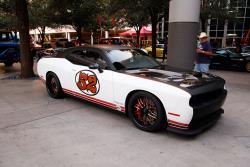
El Dodge Challenger Hellcat de 2016 en el espectáculo SEMA (Asociación de Mercado de Equipamiento Especial) 2016

El número “52” en las puertas del coche representan los 52 años que habrá estado K&N en 2016

El Hellcat de Tom estaba de muestra en el especta´culo SEMA 2016, lleno hasta arriba de mejoras que la mayoría de entusiastas harían si se despertasen y encontrasen un Hellcat en su garage.

El exterior en dos tonos con acentos naranja y rojo de los colores de K&N es trabajo de Brian Wenzel para Frontier Graphics en Denver, Colorado. La compañía de Brian ha pintado coches para espectáculos de coches, carreras, vehículos para negocios locales, e incluso flotas como los Subarus para el equipo de ski Nordica. Por cierto, Tom McGann ha dividido su carrera entre en rendimiento automotriz y los deportes de riesgo de invierno, así que está claro que es un tipo al que le gustan las cosas que van rápido.

Un detalle exterior difícil de ignorar son las pegatinas redondas en las puertas del piloto y co-piloto, que contienen el número 52. Mientras que la mayoría de veces un número en los lados de un coche de ciudad hace que venga a tu mente el General Lee, estos número tienen mayor significado que simplemente una copia de lo que estaba pintado a los lados de un coche especialista de la televisión. El 52 en el Hellcat de McGann representa el hecho de que el 2016 fue el quincuagésimo segundo año de negocio para K&N.
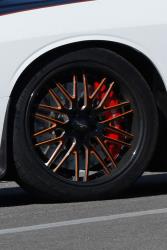
El naranja de los embellecedores de las ruedas está muy cercano al del logo de K&N

Las ruedas Savini embellecidas con naranja y muelles Eibach Pro-Kit ayudan a completar la apariencia del Hellcat 2016

De entrada, el capó del Dodge ha sido reemplazado por una preciosa unidad de fibra de carbono de Anderson Composites, con un consumo de aire alargado y conductos de ventilación de aire caliente.

Conectando el coche al neumático hay un juego de ruedas Savini SV25-S. Tom eligió estas bellezas forjadas de 20 pulgadas de entre 491 ruedas diferentes que Savini tenía disponibles para el Challenger. Forjadas, con un borde de fibra de carbono, las ruedas tienen un acabado negro con acentos naranjas en los radios - un sutil saludo al naranja que ha aparecido en el logo de K&N durante muchos años.

Para eliminar el molesto hueco entre la parte de arriba de los neumáticos y el borde del guardabarros, un conjunto de muelles Eibach Pro-Kit enrollados progresivamente, bajando el Hellcat 1.1 pulgadas en la parte de delante, y 1.2 en la parte de atrás. Un beneficio añadido de bajar la altura del coche es que convierte al Hellcat en un poco más aerodinámico, aumentando potencialmente su velocidad en la pista.
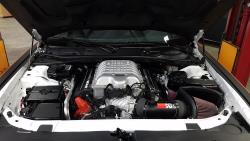
Las partes K&N Typhoon reemplazan por completo la toma de aire OEM, suavizando el flujo para tener más poder.

El sistema de toma de aire frío K&N estimula la potencia de salida hasta casi 40 caballos en las ruedas traseras.

Y por supuesto qué otra cosa podía haber bajo el capó del coche del Presidente de K&N que un sistema de toma de aire frío de las Series K&N 69. El sistema de toma de aire frío K&N 69-2550TTK es un sistema con tubo de inducción de aluminio curvado con madril, diseñado para encajar en modelos selectos 6.2L Dodge Challenger, Charger SRT, y por supuesto Hellcat. Los restrictivos filtro de aire y carcasa de toma de fábrica han sido completamente reemplazados por el sistema K&N, que ha sido diseñado para reducir dramáticamente la turbulencia en el flujo de aire. La recompensa es grande con el Hellcat - el 69-2550TTK añade un aumento estimado de unos increíbles 38.95 caballos de potencia en las ruedas traseras. Como añadido a más poder, el sistema incluso provoca más mejoras el el sonido del motor del Hellcat, con una acústica más agresiva y profunda durante la aceleración.

Si te encuentras en el lado norte de Riverside,California, en un día laborable y ves un Hellcat rebajado con un 52 en las puertas, no se trata del equipo del muelle carga en un encargo para comprar tacos, se trata del Presidente de K&N Engineering yendo hacia un encuentro de negocios donde su negocio es el rendimiento.

clear

BUSQUEDA DE PRODUCTO K&N     DONDE COMPRAR K&N

Ryan Newman Wins the Camping World 500 at Phoenix International Speedway

Ryan Newman, Pit Crew, K&N, NASCAR

Ryan Newman's crew celebrates the win at Phoenix International Speedway

Ryan Newman won the fourth Monster Energy Cup Series race of the season at Phoenix International Raceway for the Camping World 500. This was Newman’s first win in 127 races, the longest drought of his career.

“It's sweet for so many reasons. I said that when I won the Brickyard. I said that when I won at Daytona” Newman said. “This has been the longest drought I've ever been in. Even in Phoenix, the runners up suck. It's just a hard-fought race, a hard-fought battle, a hard-fought four years. I got to thank Richard and Judy, everybody at RCR, ECR, for not only giving me the opportunity to drive the racecar, but giving me a racecar that's in contention to win a race”.

This was also the first win for Newman’s crew chief Luke Lambert in 157 attempts.

“Yeah, it's really, really hard to assess the magnitude right now. I can't say enough about what it means” Lambert said. “I couldn't be prouder of everybody within the company, everybody on my race team. Ryan, you know, everybody has really worked very, very hard to get us here where we are today. I said earlier, I think Ryan really left it all on the racetrack today. He was exhausted”.

Kyle Larson, K&N, NASCAR, Camping World 500

Kyle Larson racing during the Camping World 500

Newman made a risky move at the end of the race, not going into the pits for a tire change, on a two lap overtime run, setup this overdue win. Newman led once for six laps. He won 42 points and five playoff points. He ranks 11th overall in the Monster Energy Cup Standings.

Kyle Larson once again came in second place, staying in that spot for the third race in a row and fourth time in five races this season. He led three times for a total of three laps.

“But, yeah, you know, it was a fun race for us. We ran no worse than fourth I think all race. Was really happy about that” Larson said. “Challenged for the segment win there the first stage with Joey. That was a lot of fun. Finished second, I think, the second stage, too. Second overall”.

Kyle Busch came in third place, leading twice for a total of 114 laps and the majority of the race.

Ryan Newman, Pit Crew, K&N, NASCAR, Camping World 500

Ryan Newman and his crew celebrate his Camping World 500 win

Busch would have had an easy path to the finish line, if it had not been for Joey Logano’s blown tire, that caused a caution with five laps to go.

Joey Logano won the first stage of the race and also won 1 playoff point. Chase Elliott won the second stage of the race and 1 playoff point as well.

Larson leads the Monster Energy NASCAR Cup Series standings with 184 points, and no playoff points. Brad Keselowski is in second place with 178 points and 5 playoff points. Chase Elliott is in third place with 171 points and 1 playoff point.

The next race in the Monster Energy NASCAR Cup Series will be at the Auto Club Speedway for the Auto Club 400.

clear

K&N PRODUCT SEARCH     WHERE TO BUY K&N

Chris Eggleston Wins NASCAR K&N Pro Series West Opener in Tucson, Arizona

NASCAR K&N Pro Series West's Chris Eggleston trophy at Tucson Speedway

Chris Eggleston celebrates after winning the NASCAR K&N Pro Series West opener at Tucson Speedway

As far as comebacks go, Chris Eggleston is off to a great start.

The 2015 NASCAR K&N Pro Series West champion said he was negotiating with Bill McAnally Racing until February to bring him back for another season. Eggleston rewarded McAnally by winning the K&N Pro Series West season opener at Tucson Speedway.

“This win’s big. It means a lot to me,” Eggleston said. “I really didn’t have a ride going into January almost end of February. Bill and [my sponsors], they brought me back for another year. Couldn’t be more happy or proud. This win is definitely for them for bringing me back.”

Eggleston led for 80 laps in the NAPA Auto Parts Tucson 150. He passed Todd Gilliland, the reigning K&N Pro Series West champion, on lap 92 and was out front for the last 58 laps of the race.

“I had to use up my stuff a little sooner than I wanted to, to get around Todd and it worked out all right,” Eggleston said. “Those last few cautions also had me nervous too. But man this was digging at the top. Finally got a Tucson win. This is awesome. Best way to start the season.”

There were six cautions for 28 laps and two cautions over the last 30 laps of the race. Eggleston was able to maintain his lead through both restarts.

NASCAR K&N Pro Series West's Chris Eggleston Wins at Tucson Speedway

Chris Eggleston takes a victory lap after winning the K&N Pro Series West race at Tucson Speedway

“It’s a little shot in the arm obviously,” Eggleston said. “Going into the offseason you want to get a win or two going into the season. To get the first one out of the way for the first race of the season is huge for us, Hopefully we can just start clicking them off. Make sure we get good solid points days and keep going.”

Eggleston and Gilliland battled for the lead in the first half of the race. They swapped the lead four times.

“I don’t think we had a car to win that first segment,” Eggleston said. “We made just the right adjustments at that halfway break on that pit stop. We had a really good car that second half.”

Gilliland won the pole and led the first four laps of the race. Eggleston passed Gilliland for the lead. Gilliland took it back on lap 25. They swapped the lead again and Gilliland was out front from laps 32 to 91. Gilliland led for 70 laps.

“It was definitely a good race weekend for us,” Gilliland said. “I can’t complain with a second place finish after leading more than half the laps. This stuff happens. It’s the defeat, but it’s not really the defeat when you finish second. Strong run by the Bill McAnally Racing with the one-two finish. I think our packages are very good. It’s crazy how different they are.”

NASCAR, K&N Pro Series West, Chris Eggleston, Tucson Speedway

Chris Eggleston led 80 laps in the NASCAR K&N Pro Series West race at Tucson Speedway

Rookie Garrett Archer was third after qualifying and starting the race in the 16th spot. In only his second K&N Pro Series West start, Archer jumped from sixth place to second on the final restart. But Gilliland passed Archer to finish second before the checkered flag dropped.

“We got to second at one point, but I think we used up just a little too much to get to the next guy,” Archer said. “Hell of a race from where we started, really good momentum heading forward.”

Zane Smith was fourth, followed by Will Rodgers in fifth.

The next K&N Pro Series West race is at Kern County Raceway Park.

clear

K&N PRODUCT SEARCH     WHERE TO BUY K&N